I’m not going to make one better than the other. These are all buildable things, and they are all design choices. What I want to show is why each one is the way it is, and why it works the way it does.
00 · The experiment
The same thing, out loud and typed
I spent an afternoon with two voice assistants, Google’s Gemini and Sesame. I asked each one the same thing, out loud and then typed: “Tell me about France.”
I got wildly different types of responses. This is a look at why.
I look at a voice assistant in three layers: how it sounds, how it behaves, and whether the two match.
01 · Layer one
Sound
In Gemini I chose a voice called Ursa. There are a lot of voices in there, and they’re good voices. They don’t sound robotic. They’re chatty and conversational. Ursa is an efficient and friendly assistant voice.
In Sesame I chose Maya, one of four named characters. Her voice does something specific. You get pauses. You get little sounds, like throat clearing. You can hear her tongue. It sounds like a human.
I don’t hear those sounds and pauses in Ursa.
That is part of why Sesame’s voice got so much attention. But it’s more than just those sounds.
Why it sounds this way. The more natural you want a voice and a persona to sound, the broader the range of real conversation you need behind it. Pauses and breath show up in a voice when they were in the conversations it learned from. A voice like Ursa’s is built for a different job: clear, even, and the same every time.
02 · Layer two
Behavior
Both assistants adapt for voice. They’re just doing it differently.
| Typed | Spoken | |
|---|---|---|
| Gemini | A reference page: a summary, a Quick Facts table, sections on geography, history and culture, then “Where would you like to focus next?” | Two sentences, then a question: regions, or culinary traditions? |
| Sesame | Headers and bullets, shorter, opening with “Here’s what I find most interesting.” | A take, with no list of facts: “What I love about France is that the whole country is basically obsessed with ‘terroir’.” |
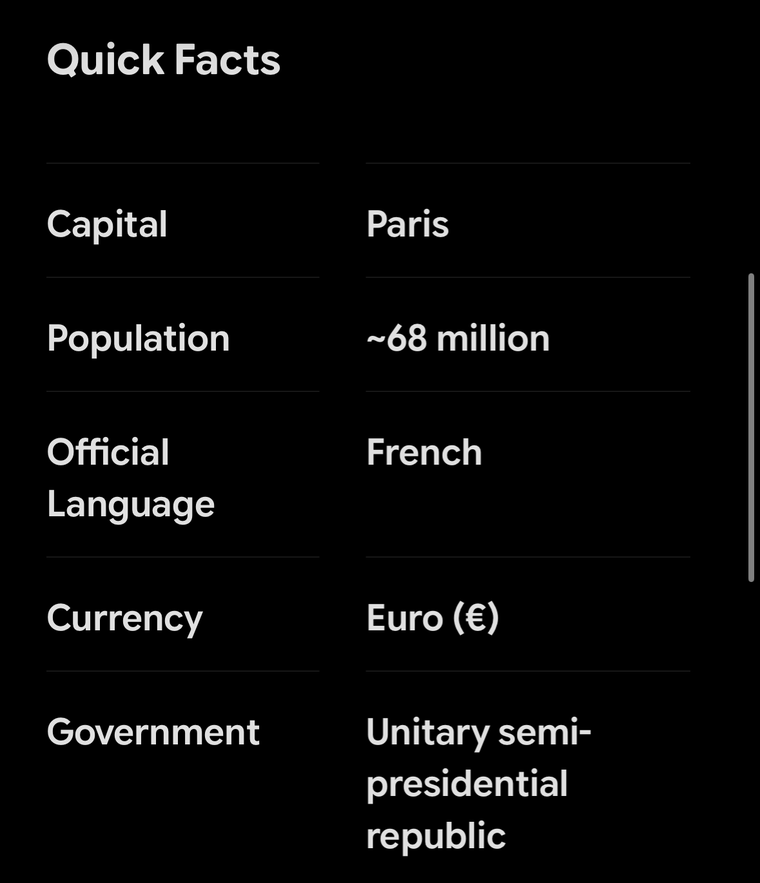
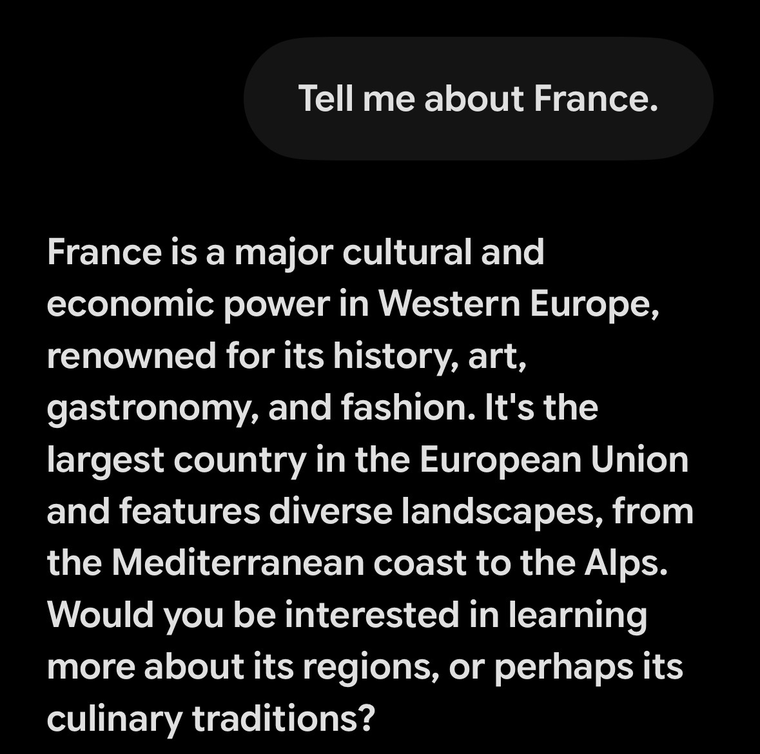
Gemini shortens. That’s the classical voice stuff. You can’t say as much out loud, it’s overwhelming, so it shortens. Gemini is saying: I’m just going to adjust this for voice form.
Maya is saying: I’m going to have different behavior as a voice agent.
The first time I asked her about France, it was almost poetic. She called it the land of butter. She had strong opinions about bread. She went on and on. She did not list me a whole bunch of facts. She included some, but the way she delivered it was so unassistant-like.

The assistant answer still exists. Maya wrote a high-level overview of France, with the revolutions, the republics and the regional identities. But she didn’t speak it out. She put it on the screen.
Voice mode is not for the stuff that voice is bad at. It’s for the stuff that voice is good at.
That’s a real choice.
Why it behaves this way. Training data is not enough. You also have to guide behavior. Someone decided what Maya does with an open question: take a stance, follow one idea, go long, and put the reference material in a note. Someone decided Gemini answers in two sentences and offers a choice of two. Those are written rules, whatever each team calls them.
03 · Layer three
The match
Each assistant holds together. Ursa’s clean, efficient voice fits a short, neutral answer. Maya’s pauses and thinking sounds fit a personal answer that wanders. Swap them and both break: breath and throat sounds on a two-sentence answer would promise a person the writing doesn’t deliver.
So this isn’t one design that works and one that doesn’t. It is two designs that each make sense, built on different ideas of what a voice assistant is for.
Why it holds together. A match like this doesn’t happen by accident. A voice that sounds like one character has to behave like that same character. Someone has to hold the through line: the voice, the behavior, and the technical choices that make them one.
It also made me wonder whether what people love about Sesame is really all about the voice. They may be responding to the quality of her responses as well. Part of the attention is the way they treat the voice. The other part is that her persona work and behavior is decidedly different.
04 · Trade-offs
What each choice costs
Maya is very conversational. If I interrupted her and said, no, really, please tell me something about France, I bet she would. But that ends up being more like a conversation with a person. Sometimes a person starts to go off, and you have to say: I really need to stay on this topic, can you answer the question?
Gemini gives a definitely assistant-like response. It answers, then asks where I want to go.
Who steers. Gemini takes a short turn and hands the choice back. Maya takes a long turn and drives. With her, keeping the conversation on track is the listener’s job.
Where the facts go. The overview went to a note, not into the call. If you’re talking to the voice and need fast or complicated information, you may need a screen, or you may need to keep Maya on topic.
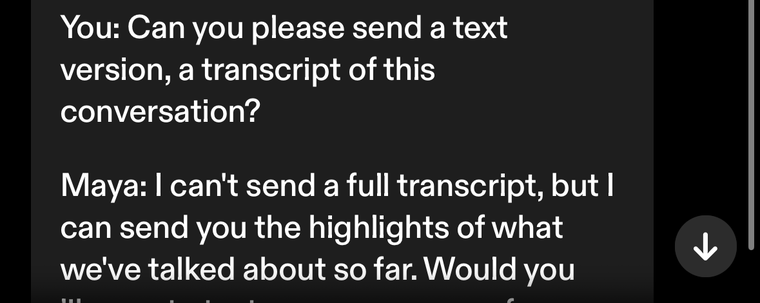
What she says she can do. In one afternoon Maya gave three accounts of the same ability: no record unless you ask during the call, then highlights only, then the whole text. A strong character makes a wrong statement easy to forgive. It also makes it harder to notice.
Why that happens. You get more unexpected things when a lot of the pipeline is left to the model’s judgment in the moment. Whether a transcript can be sent is a fixed fact about the product. It sounds like the answer was left for her to work out each time.
Sesame has gone with a rather bold design choice.
05 · The state of voice
Two bets on what voice is for
Both of these are current, well-made products, and they have made opposite bets. One treats voice as another way to reach the same assistant. The other treats voice as its own medium, with its own job.
Neither bet is wrong and neither product is finished. Most of the field is still deciding which one it is building. These are all buildable things, and they are all design choices.
06 · Limits
What I haven’t tested
A plain task. A reminder, or a fact I need right now. Maya may get much closer to Gemini there, or stay in character and make me wait.
Interrupting her. I bet she would answer if I pressed. That is still a bet.
Voice with no screen. Sesame says it is making glasses. When there’s no screen, will Maya’s behavior get a little less conversational?